If you are searching for the most remote, most untouched, and most spiritually profound trekking experience in all of Nepal — the Upper Dolpo Trek 25 Days with TrekkingKey is the answer. Tucked deep in the far northwestern corner of Nepal behind the towering wall of the Dhaulagiri Himalaya, Upper Dolpo is a land that time has barely touched. Declared a restricted area to protect its extraordinary cultural and ecological heritage, this high-altitude Tibetan plateau world receives only a tiny fraction of the visitors that flock to the Everest or Annapurna regions — making every step through its ancient valleys a genuinely rare and privileged experience.
Upper Dolpo is the inspiration behind Peter Matthiessen’s celebrated book ‘The Snow Leopard’ and the setting of the acclaimed Nepali film ‘Caravan.’ It is a land where the Bon Po religion — the ancient shamanic faith that predates Buddhism in the Himalayas — still thrives alongside Tibetan Buddhism, where ancient monasteries carved into cliffside rock have stood for nearly a thousand years, and where the Dolpo-pa people continue a way of life shaped by yak herding, barley farming, and spiritual practice at altitudes that would challenge most travellers simply to breathe.
The 25-day itinerary designed by TrekkingKey takes you from Kathmandu by flight to Nepalgunj and then onward to the remote airstrip at Juphal — the gateway to Upper Dolpo. From here the trek penetrates deep into the heart of this extraordinary region: past the turquoise miracle of Phoksundo Lake — Nepal’s deepest and most beautiful lake — over the breathtaking Nangdalo (Kangla) Pass (5,360m), down to the ancient Bon Po monastery of Shey Gumba (founded in the 11th century), through the sacred monasteries of Namgung and Yangjer Gumba, across the wild and remote passes of Sela (Shey) Bhanjang (5,010m) and Jyanta Bhanjyang (5,221m), through the hidden valley settlements of Sugugaon, Dho Tarap, and Tarakot, before returning to Juphal for the flight home.
This is not a trek for the faint-hearted. It is a 25-day expedition into one of the last truly wild places on earth — a journey requiring strong physical fitness, genuine adventure spirit, and a deep curiosity for the world’s most extraordinary cultures. With TrekkingKey’s expert team — experienced licensed guides, trained cooks, reliable porters, and unwavering 24/7 support — every step of this remarkable journey is in the best possible hands.
QUICK FACTS
| Duration | 25 Days |
| Max Altitude | 5,360m / 17,585ft (Nangdalo / Kangla Pass) |
| Difficulty | Strenuous / Advanced |
| Trek Distance | ~220 km / 137 miles (approx.) |
| Daily Walking | 4–8 hours |
| Start / End | Kathmandu, Nepal |
| Transport | Flight: Kathmandu–Nepalgunj–Juphal (return same route) |
| Best Season | Spring (Mar–May) & Autumn (Sep–Nov); Summer possible (rain-shadow) |
| Accommodation | 3-Star Hotel Kathmandu + Guest House Nepalgunj + Tent Camps on trek |
| Group Size | Min. 2 – private & group departures available |
-
Bus
-
1-30
-
5360 m
-
1
-
79
- Cross the dramatic Nangdalo (Kangla) Pass (5,360m) — the highest and most exhilarating point of the entire trek, with sweeping Himalayan panoramas
- Discover Phoksundo Lake — Nepal’s largest and deepest lake, a breathtaking turquoise jewel set within sheer canyon walls at 3,733m
- Explore the ancient Shey Gumba — an 11th-century Bon Po monastery, one of the oldest and most sacred in the entire Himalayan world
- Visit the revered Namgung Gumba and Yangjer Gumba — extraordinary cliff-perched monasteries of profound spiritual and architectural beauty
- Cross the Sela (Shey) Bhanjang (5,010m) and Jyanta Bhanjyang (5,221m) — three high passes in one incredible trek
- Trek through one of Nepal’s most remote and least-visited restricted regions — genuine Himalayan wilderness with almost no tourist footprint
- Experience the extraordinary Bon Po and Tibetan Buddhist culture of the Dolpo-pa people — a civilisation unlike anywhere else in Nepal
- Walk through the hidden villages of Ringmo, Nisalgaon, Sugugaon, Khomagaon, Shimengaon, Tinjegaon, and Dho Tarap — living time capsules of ancient Himalayan life
- Marvel at panoramic views of Kanjirowa Himal (6,612m), She-Shikhar (6,139m), Yala (5,900m), Norbung (6,085m), and Jhyarko Dingla (5,892m)
- Trek through Shey Phoksundo National Park — home to snow leopards, Himalayan thar, blue sheep, Tibetan wolves, and rare Himalayan birds
- Discover ancient Bon and Buddhist mani walls, chortens, stupas, and prayer flag forests throughout the hidden valleys
- Camp under the most star-filled skies in Nepal — the extreme remoteness and zero light pollution of Upper Dolpo makes for extraordinary night sky experiences
- Follow the historic trans-Himalayan yak caravan salt trade route, still alive in the cultural memory and traditions of the Dolpo-pa
Experience the inspiration behind ‘The Snow Leopard’ by Peter Matthiessen — one of the greatest adventure travel books ever written
Welcome to Kathmandu — Nepal's ancient capital and the gateway to the world's greatest mountain adventures. A TrekkingKey representative will greet you at Tribhuvan International Airport and transfer you to your hotel in Thamel. This extraordinary city of medieval temples, bustling markets, and Himalayan energy is the perfect starting point for your Upper Dolpo odyssey. Spend the afternoon resting from your journey or exploring Thamel's vibrant trekking shops and restaurants. In the evening, your TrekkingKey expedition leader will meet you for a full briefing on the 25-day itinerary, gear requirements, restricted area permits, safety protocols, and camping logistics. A traditional Nepali welcome dinner rounds off your first evening in Nepal.
Accommodation: 3-Star Hotel | Meals: Welcome Dinner
Today is dedicated to completing the essential permit documentation for the Upper Dolpo restricted area — a critical administrative step that your TrekkingKey team handles seamlessly. Both the Upper Dolpo Restricted Area Permit and the Lower Dolpo permit (required for transit sections) are processed, along with Shey Phoksundo National Park entry fees and TIMS card. While the permits are being arranged, you are free to explore Kathmandu Valley's UNESCO World Heritage Sites — the magnificent Boudhanath Stupa, the sacred Pashupatinath Temple, and the hilltop Swayambhunath. In the afternoon, meet your TrekkingKey guide and support crew for a comprehensive expedition briefing, gear check, and introduction to the camping and cooking arrangements that will be your home for the next three weeks.
Accommodation: 3-Star Hotel | Meals: Breakfast
An early morning transfer to Tribhuvan International Airport for the one-hour domestic flight southwest to Nepalgunj — a warm, flat city near Nepal's border with India that serves as the transport hub for all flights into the far west of Nepal. The contrast from Kathmandu's mountain-rimmed valley to Nepalgunj's tropical plains is striking and immediate. Arrive in Nepalgunj and transfer to your guest house. The afternoon is free to rest, repack your kit for the expedition ahead, and acclimatise to the warm lowland air before tomorrow's early morning flight deeper into the mountains. Your TrekkingKey cook prepares a nutritious dinner at the guest house — the first of many excellent camp meals ahead.
Flight: ~1 hr | Accommodation: Guest House | Meals: Breakfast, Lunch & Dinner
An early morning flight from Nepalgunj to Juphal — a tiny mountain airstrip perched in the hills of the Dolpo district — one of the most scenic and exciting short flights in Nepal, threading between towering Himalayan ridges. Land at Juphal (2,475m) and meet the full TrekkingKey expedition team: your guide, cook, and porter crew who will be your companions for the next 21 days of trekking. After equipment checks and a brief orientation, begin the first section of trail with a three-hour downhill walk to Dunai — the district headquarters of Dolpo — a charming riverside town on the banks of the Bheri River. Set up the first camp, enjoy your first hot meal from the TrekkingKey camp kitchen, and absorb the reality that your extraordinary Upper Dolpo adventure has truly begun.
Flight: ~30 min | Walking: ~3 hrs | Accommodation: Tent Camp | Meals: Breakfast, Lunch & Dinner
The first full day of trekking follows the Suli Gad River valley north from Dunai, steadily ascending through a landscape of pine forest, terraced farmland, and dramatic gorge scenery. The trail passes through scattered Magar and Chhetri settlements where village life continues essentially unchanged from centuries past — women weaving at hand looms, children chasing yaks in terraced fields, and elders spinning prayer wheels outside stone doorways. The air becomes noticeably cleaner and cooler as altitude is gained. Camp at Shyanta, a small settlement in the valley, where the first clear views of the high peaks framing the upper Dolpo begin to appear above the treeline to the north. The TrekkingKey cook prepares a warm, hearty dinner under the open sky.
Walking: ~5–6 hrs | Accommodation: Tent Camp | Meals: Breakfast, Lunch & Dinner
Continue ascending through the Suli Gad valley, with the trail becoming progressively more dramatic as the gorge deepens and the walls on either side rise to extraordinary heights. The path crosses several wooden bridges over the rushing river and passes through sections of dense juniper and birch forest before emerging onto open hillsides with expanding mountain panoramas. The cultural character of the settlements shifts subtly northward, with the first Bon Po mani walls and prayer flag strings appearing alongside the trail — signs that you are approaching the high-altitude Tibetan Buddhist world of inner Dolpo. Camp at Rechi, a beautiful location in the valley with clean mountain air and the first genuinely cold night of the expedition.
Walking: ~5–6 hrs | Accommodation: Tent Camp | Meals: Breakfast, Lunch & Dinner
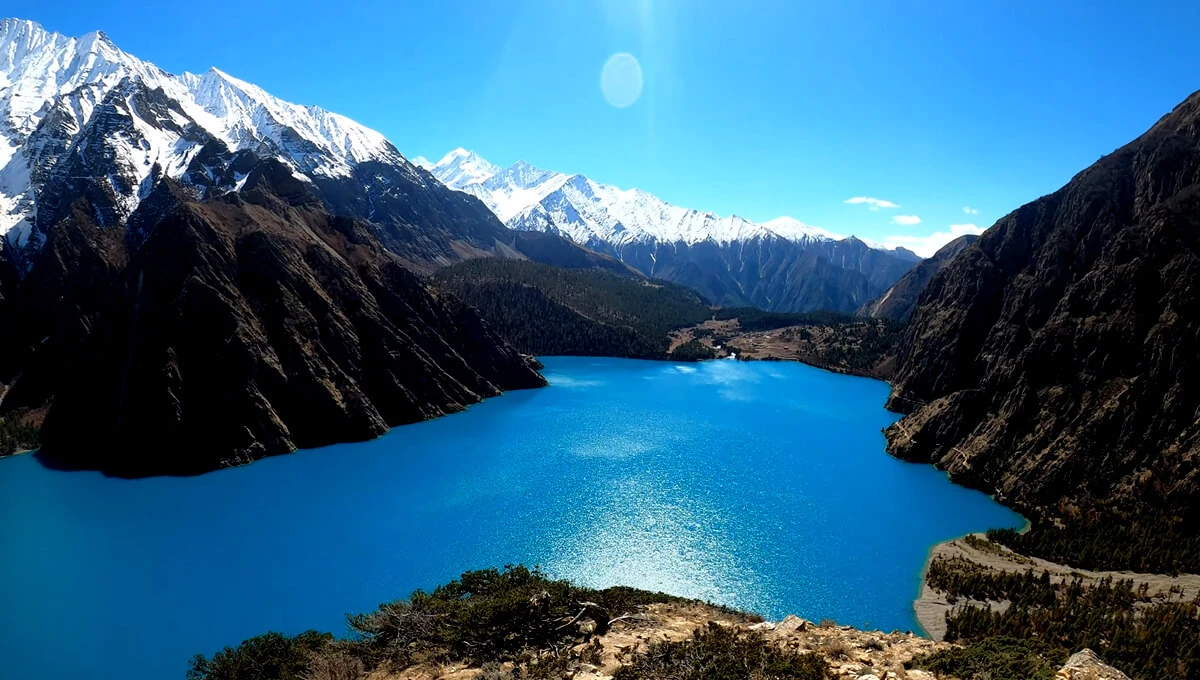
Today brings one of the most anticipated and visually stunning moments of the entire 25-day trek — the first sight of Phoksundo Lake. The trail continues up the gorge through increasingly wild and remote terrain, crossing the dramatic Phoksundo waterfall — one of the highest waterfalls in Nepal, plunging in a thundering cascade of white water into the gorge below — before the final ascent brings you to the rim of the lake basin. The sight of Phoksundo Lake stops every trekker utterly in their tracks: a vast expanse of impossibly turquoise water — the deepest lake in Nepal at over 145 metres — set within sheer canyon walls of red and ochre rock, ringed by snow-capped peaks and utterly silent. The small village of Ringmo sits at the lake's southern shore, its traditional stone houses, prayer flags, and ancient monastery creating a scene of extraordinary beauty. Camp beside the lake and spend the evening watching the light change on the water.
Walking: ~5–6 hrs | Accommodation: Tent Camp | Meals: Breakfast, Lunch & Dinner
A full rest and acclimatisation day beside Phoksundo Lake — essential before ascending to the higher passes ahead, and one of the most peaceful and restorative days of the entire trek. The morning is free to explore the shores of the lake, hike to viewpoints above the waterline for aerial perspectives of the turquoise expanse, and visit the Ringmo village Gompa — an ancient monastery whose faded murals and butter lamp-lit interior evoke centuries of unbroken Tibetan Buddhist practice. The afternoon invites quiet reflection by the lakeshore, photography, and rest. The silence of this place is extraordinary — the only sounds are wind on water, prayer flags snapping, and the occasional bark of a distant yak. Your body acclimatises to the 3,733m altitude while your spirit absorbs the profound beauty of one of Nepal's most remarkable natural wonders.Rest / acclimatisation hike | Accommodation: Tent Camp | Meals: Breakfast, Lunch & Dinner
Departing the magical shores of Phoksundo Lake, the trail heads north and upward into increasingly wild, high-altitude terrain. The path climbs steadily through ancient juniper and birch forest — the trees gnarled and wind-shaped by decades of mountain storms — before breaking above the treeline into open alpine terrain of boulder fields, glacial streams, and vast mountain silence. The scale of the Dolpo landscape becomes apparent here: immense, austere, and achingly beautiful under the deep blue sky of the high Himalayas. Camp is established at the Forest Camp — the last significant tree cover before the treeless alpine zone above — where the TrekkingKey cook prepares a warming dinner as the temperature drops sharply with the setting sun. Tomorrow's pass crossing preparation begins with a thorough equipment check and early rest.
Walking: ~5–6 hrs | Accommodation: Tent Camp | Meals: Breakfast, Lunch & Dinner
A shorter but important altitude-gain day as the trail pushes above the last remnants of vegetation into the raw, high-altitude landscape directly below the Nangdalo Pass. The terrain here is elemental — a world of rock, ice, glacial moraine, and the immense silence of the high Himalayas. The base camp for the Nangdalo (Kangla) Pass is established at a relatively sheltered spot below the final ascent, allowing ample time for rest, hydration, and preparation for tomorrow's early-start crossing. Views of the surrounding peaks — Kanjirowa Himal (6,612m), She-Shikhar (6,139m), and other unnamed giants of the Dolpo massif — are extraordinary in the late afternoon light. Dinner is eaten early, layers are laid out, alarms are set, and the camp settles into anticipatory silence before the biggest day of the trek.Walking: ~5 hrs | Accommodation: Tent Camp | Meals: Breakfast, Lunch & Dinner
The crown jewel of the Upper Dolpo Trek — a long, physically demanding, and utterly magnificent day. Rise before dawn (typically 4:30–5:00 AM) and begin the ascent to the Nangdalo (Kangla) Pass (5,360m) in the cold darkness, headlamps illuminating the rocky trail above. The climb is relentless and demanding, ascending through glacial moraine, snow fields, and icy boulder terrain. As the sky lightens, the Himalayan panorama around you reveals itself in stages — first the silhouettes of neighbouring peaks against the dawn sky, then the full golden spectacle of Kanjirowa Himal, She-Shikhar, and the vast Tibetan plateau spreading to the north. At the summit, a mass of prayer flags marks this extraordinary high point — at 5,360m the highest pass of the entire trek and one of the highest trekking passes in western Nepal. Breathe, photograph, and absorb the immensity of this achievement before beginning the long descent to the ancient Bon Po sanctuary of Shey Gumba (4,160m). The descent is steep and requires careful footing, dropping over 1,200 metres through dramatic high-altitude terrain to the valley below.
Walking: ~7–8 hrs | Accommodation: Tent Camp | Meals: Breakfast, Lunch & Dinner
A full rest and exploration day at Shey Gumba — one of the most historically and spiritually significant sites in the entire Himalayan world. Shey Gumba is a Bon Po monastery founded in the 11th century, perched in a dramatic high-altitude valley below the grey walls of Crystal Mountain — the sacred peak described so powerfully by Peter Matthiessen in 'The Snow Leopard.' The monastery complex contains ancient chambers filled with centuries-old murals, butter sculptures, sacred texts, and ritual objects of extraordinary beauty and historical significance. Monks perform daily rituals in smoke-darkened prayer halls where little has changed in a thousand years. Take time to walk the kora (circumambulation path) around Crystal Mountain, explore the surrounding landscape, and simply sit in the profound silence of this remarkable place. The valley is also one of the best locations in Nepal for snow leopard sightings — keep your eyes on the high ridges and rocky outcrops above.
Rest / exploration | Accommodation: Tent Camp | Meals: Breakfast, Lunch & Dinner
Another major pass-crossing day — the second of the trek's three high passes. From Shey Gumba, the trail climbs steeply to the Sela (Shey) Bhanjang (5,010m), a high ridge crossing that rewards the effort with panoramic views of the Dolpo highlands stretching in every direction — a vast, brown, treeless plateau world broken by the white of distant glaciers and the dark blue of high-altitude lakes. The descent from Sela Bhanjang leads through increasingly dramatic cliff-side terrain to the extraordinary Namgung Gumba (4,430m) — a monastery perched on a rocky shelf high above the valley floor, its whitewashed walls and golden rooftop ornaments visible from far below. The interior of Namgung Gumba is richly decorated with ancient thangka paintings, elaborate butter lamp altars, and sacred relics of the Tibetan Buddhist tradition. Camp is established nearby.
Walking: ~6–7 hrs | Accommodation: Tent Camp | Meals: Breakfast, Lunch & Dinner
A relatively shorter day as the trail descends from Namgung Gumba into the broad, fertile valley of Saldang — one of the largest and most prosperous villages in the entire Upper Dolpo region. The descent reveals the dramatic scale of the inner Dolpo landscape: wide, flat-bottomed valleys flanked by towering brown ridges, interspersed with patches of brilliant green where barley and buckwheat are grown on terraced fields irrigated by glacial streams. Saldang is a large, spread-out settlement of traditional flat-roofed Tibetan-style houses, with a significant monastery and the warm, curious hospitality of Dolpo-pa families who rarely encounter outside visitors. The afternoon provides an excellent opportunity to explore the village, photograph daily life, and interact with the local community through your TrekkingKey guide's translation.
Walking: ~4–5 hrs | Accommodation: Tent Camp | Meals: Breakfast, Lunch & Dinner
From Saldang, the trail continues through the high valley landscape of inner Upper Dolpo, passing through remote settlements of extraordinary cultural richness. The route traverses hillsides dotted with ancient mani walls, prayer flag columns, and chorten clusters that mark every significant landscape feature. Yangjer Gumba — the third of the trek's major monastery destinations — appears dramatically on a rocky hillside, its multi-storey structure rising from the cliff face like a natural extension of the rock itself. The interior of Yangjer Gumba houses some of the finest and best-preserved ancient murals in Upper Dolpo, depicting scenes from Tibetan Buddhist cosmology and the life of Guru Padmasambhava. The monks who maintain this remote sanctuary represent one of the last repositories of a living Bon and Buddhist monastic tradition that has survived unchanged for centuries.
Walking: ~5–6 hrs | Accommodation: Tent Camp | Meals: Breakfast, Lunch & Dinner
Continuing through the remote high valleys of Upper Dolpo, today's trail passes through some of the region's most hidden and least-visited settlement areas. The villages of this inner region — Khomagaon, Shimengaon, and Sugugaon — are extraordinary in their isolation and their cultural preservation. Stone houses with flat mud roofs, dried yak dung stacked for winter fuel, prayer flags tied between juniper poles, and the sound of hand-turned prayer wheels being spun by passing elders create a scene that feels centuries removed from the modern world. The mountain scenery throughout this section is magnificent — wide valley floors, towering brown ridges, and the occasional flash of a glaciated peak above the skyline. Camp at Sugugaon, where the TrekkingKey cook prepares a hearty dinner as the temperature drops sharply in the thin high-altitude air.Walking: ~6–7 hrs | Accommodation: Tent Camp | Meals: Breakfast, Lunch & Dinner
A long, altitude-gaining day as the trail climbs steadily from Sugugaon toward the base camp for the trek's third and final high pass — the Jyanta Bhanjyang. The landscape becomes increasingly austere and elemental as altitude is gained — the last settlements and cultivated terraces are left behind, and the trail enters the raw wilderness of the pre-pass zone: rocky hillsides, glacial streams, alpine meadows cropped short by yak grazing, and the immense silence of high-altitude Nepal broken only by the wind. Camp is established at the Jyanta Bhanjyang Phedi (4,900m) — a high, exposed location requiring full expedition sleeping gear and clothing. Tomorrow's early-start crossing demands thorough rest, hydration, and preparation. The stars at this altitude, far from any light pollution, are extraordinary.
Walking: ~6 hrs | Accommodation: Tent Camp | Meals: Breakfast, Lunch & Dinner
The final high pass of the Upper Dolpo Trek — the Jyanta Bhanjyang (5,221m) — and another magnificent dawn crossing. Rise early and begin the ascent in the pre-dawn cold, climbing through rocky, icy terrain to the prayer-flag-festooned summit. At 5,221m, the panorama is extraordinary — a 360-degree view of the Dolpo highlands, the peaks of the Kanjirowa Himal massif, the distant glitter of Phoksundo Lake far below to the southwest, and the vast brown plateau world stretching to the north toward Tibet. After the summit, a long and satisfying descent through boulder fields and alpine meadows leads to the remote valley settlement of Tokyu (4,209m) — a small, traditional Tibetan-style village where the warmth of lower altitude and the shelter of the valley walls comes as a genuine relief after the exposed high camp. A triumph of a day.
Walking: ~7–8 hrs | Accommodation: Tent Camp | Meals: Breakfast, Lunch & Dinner
From Tokyu, a relatively straightforward descent through the spectacular Tarap valley leads to Dho Tarap — the largest and most culturally significant village in the Lower Dolpo portion of the route, and a place of extraordinary beauty and character. The Tarap valley is one of the finest in all of Nepal: a wide, flat-bottomed glacial valley flanked by towering rock walls, with the Tarap Chu river running clear and cold through fields of barley and buckwheat. Dho Tarap itself is a sizeable settlement of traditional flat-roofed houses, a significant monastery, and a community of Dolpo-pa people who maintain traditional semi-nomadic practices alongside settled agriculture. The descent from the high pass world into this fertile valley feels like emerging from another planet — the greens of cultivated fields and the warmth of the lower air are deeply welcome after days in the austere high country.
Walking: ~4–5 hrs | Accommodation: Tent Camp | Meals: Breakfast, Lunch & Dinner
The long descent begins in earnest as the trail leaves the high Dolpo plateau world and begins working its way south and downward through the dramatic gorge system of the lower Bheri River watershed. From Dho Tarap, the trail follows the Tarap Chu River downstream through narrowing canyon walls, crossing and recrossing the river on wooden bridges as the valley constricts. The vegetation gradually returns as altitude is lost — first alpine scrub and sparse juniper, then steadily denser pine and rhododendron forest as the trail drops into the mid-mountain zone. Camp at Nawalpani, a riverside location where the roar of the river and the warmth of lower altitude make for a dramatically different camping experience from the cold, wind-exposed sites of the past two weeks.
Walking: ~6 hrs | Accommodation: Tent Camp | Meals: Breakfast, Lunch & Dinner
Continue the gradual descent through the lower Dolpo valleys, following the river system southward through increasingly lush and green landscape. The trail passes through several small mid-hill settlements where the culture transitions back from the Tibetan Buddhist high-altitude world to the mixed Hindu and Buddhist communities of the lower valleys. Farmsteads with maize, millet, and wheat fields appear for the first time in weeks — a vivid reminder of the extraordinary altitude range this trek has covered. Camp at Laina Odar, a forested location with excellent mountain views and the pleasant sounds of lower-altitude jungle — birds, insects, and running water — providing a stark and welcome contrast to the silence of the high plateau. The end of the trek begins to feel tangible.Walking: ~5–6 hrs | Accommodation: Tent Camp | Meals: Breakfast, Lunch & Dinner
The trail continues its steady descent toward the ancient fortress town of Tarakot — a historic settlement perched dramatically on a hilltop above the Bheri River, with the ruins of a medieval fort visible on the ridge above. The approach to Tarakot passes through several riverside villages where life is lived at a markedly different pace and altitude from the high Dolpo world above — women carry water in traditional clay pots, children play in dusty courtyards, and the warmth of the lower elevation is palpable after weeks in the cold. Tarakot itself is a fascinating and historically significant settlement, with its ancient fort ruins, traditional bazaar, and the confluence of multiple ancient trade routes that once connected Dolpo with the lower hills of western Nepal. Camp beside the river in the town's outskirts.
Walking: ~5–6 hrs | Accommodation: Tent Camp | Meals: Breakfast, Lunch & Dinner
Day 23 — Tarakot to Dunai to Juphal (2,475m / 8,120ft)
The final full day of trekking — a long but satisfying walk that brings the 23-day trail journey to its conclusion at Juphal. From Tarakot, the trail descends to Dunai — the district headquarters of Dolpo where the trek began — and then climbs the familiar path back up to Juphal airstrip. The walk today is both physically familiar (retracing the approach section) and emotionally charged: the knowledge that this extraordinary adventure is drawing to its close brings a mix of triumph, nostalgia, and deep gratitude. On arrival at Juphal, the TrekkingKey team gathers for a final celebration dinner together — guides, cook, and porters who have shared every step of this remarkable journey. Tips are distributed, farewells are begun, and the last night under the vast Dolpo sky is savoured.
Walking: ~7 hrs | Accommodation: Tent Camp | Meals: Breakfast, Lunch & Dinner
An early morning departure from Juphal airstrip for the mountain flight back to Nepalgunj — one final spectacular aerial perspective of the extraordinary Dolpo landscape you have spent three weeks exploring on foot. Connect in Nepalgunj for the onward flight to Kathmandu, arriving in the capital by midday or early afternoon. Transfer to your hotel for a long-awaited hot shower, clean clothes, and the luxury of a real bed. In the evening, TrekkingKey hosts a celebratory farewell dinner at one of Kathmandu's finest Nepali restaurants — a fitting tribute to 25 days of extraordinary achievement. Raise a glass to Phoksundo Lake's turquoise waters, the Nangdalo Pass at 5,360m, the ancient prayers of Shey Gumba, and the remarkable Dolpo-pa people who call this extraordinary world home.
Flights: Juphal–Nepalgunj–Kathmandu | Accommodation: 3-Star Hotel | Meals: Breakfast, Lunch & Farewell Dinner
Your final morning in Nepal. Enjoy a leisurely breakfast and take time for last-minute souvenir shopping in Thamel — Tibetan thangka paintings, hand-carved singing bowls, traditional Dolpo textiles, and Nepalese handicrafts are all excellent mementos of this extraordinary journey. TrekkingKey will transfer you to Tribhuvan International Airport with plenty of time before your onward flight. We say farewell with warm hearts, extraordinary memories, and the profound knowledge that you have explored one of the most remote, most culturally rich, and most challenging trekking destinations on the face of the earth.
Meals: Breakfast | Airport Transfer Included Flight Note: The Juphal airstrip is small and weather-dependent. Nepalgunj–Juphal flights are frequently subject to weather delay or cancellation, particularly in winter and monsoon months. TrekkingKey strongly recommends scheduling at least one buffer day in Nepalgunj and one in Kathmandu at the end of your journey. All domestic flights are arranged by TrekkingKey.
Includes
- • All airport and hotel transfers in Kathmandu by private vehicle
- • 3 nights hotel accommodation in Kathmandu (3-star, Bed & Breakfast)
- • 1 night guest house accommodation in Nepalgunj
- • All domestic flights: Kathmandu–Nepalgunj–Juphal and Juphal–Nepalgunj–Kathmandu (including domestic airport taxes)
- • All meals during the trek — breakfast, lunch & dinner — prepared by TrekkingKey's experienced camp cook
- • Fresh seasonal fruit served as dessert each evening
- • All tent camp accommodation during the trek (20 nights)
- • Experienced, English-speaking licensed TrekkingKey guide with all food, accommodation & insurance
- • Experienced camp cook with all food, accommodation & insurance
- • Full porter crew (sufficient for all expedition equipment and personal duffel bags) with all food, accommodation & insurance
- • Upper Dolpo Restricted Area Permit and Lower Dolpo Restricted Area Permit
- • Shey Phoksundo National Park entry fee
- • TIMS (Trekkers' Information Management System) Card
- • Full expedition camping equipment: tents, kitchen tent, dining tent, sleeping mats
- • TrekkingKey duffel bag for use during the trek
- • TrekkingKey company t-shirt
- • First aid kit with fingertip pulse oximeter — oxygen saturation checked daily throughout the trek
- • Emergency helicopter evacuation coordination (costs covered by your travel insurance)
- • Government taxes (13% VAT) and all administrative expenses
- • Farewell dinner in Kathmandu
- • 24/7 TrekkingKey support
Excludes
- • International flights and Nepal visa fees (30 days: USD 40; 90 days: USD 100)
- • Personal travel and medical/evacuation insurance (mandatory — must cover trekking to 5,500m and helicopter evacuation)
- • Lunches and dinners in Kathmandu and Nepalgunj
- • All cold, hot, and alcoholic drinks during the trek (soft drinks, beer, mineral water, etc.)
- • Personal trekking gear and equipment (see packing list section)
- • Tips for guide, cook, porters, and any drivers — strongly appreciated by all field staff
- • Personal expenses — hot showers, battery charging, phone calls, Wi-Fi (extremely limited in Upper Dolpo)
- • Sleeping bags, down jackets, and trekking poles — available for rental from TrekkingKey on request
- • Extra nights in Kathmandu or Nepalgunj due to flight delays or weather disruption
Frequently Asked Questions
General
The best trekking seasons in Nepal are Spring (March to May) and Autumn (September to November). During these months, the weather is stable, mountain views are clear, and trekking conditions are ideal. However, some treks can also be done in winter and monsoon depending on the region.
No, many trekking routes in Nepal are suitable for beginners as well as experienced trekkers. Popular treks like the Ghorepani Poon Hill Trek and Langtang Valley Trek are beginner-friendly. Our team at Trekking Key helps choose the best trip according to your fitness level and experience.
Most trekking regions in Nepal require trekking permits such as:
- TIMS Card
- National Park Permit
- Restricted Area Permit (for special regions)
Our company arranges all necessary permits and documentation for your trip.
Yes, trekking in Nepal is generally safe when traveling with experienced guides and proper preparation. Trekking Key prioritizes safety by providing licensed guides, proper itinerary planning, altitude awareness, and emergency support during the trek.
Essential trekking items include:
- Comfortable trekking boots
- Warm clothes and jacket
- Sleeping bag
- Trekking poles
- Water bottle and personal medicines
- Sunscreen, sunglasses, and gloves
After booking, Trekking Key provides a complete packing list for your selected trip.
DIFFICULTY & FITNESS
The Upper Dolpo Trek is rated strenuous to advanced — one of the most physically and logistically demanding trekking expeditions available in Nepal. This is not an appropriate trek for first-time Himalayan trekkers or those without prior experience at significant altitude. The 25-day itinerary includes three high passes above 5,000m (Nangdalo/Kangla at 5,360m, Sela/Shey Bhanjang at 5,010m, and Jyanta Bhanjyang at 5,221m), multiple consecutive days of 6–8 hour walking over rough, remote, unmarked trail, and extended periods in genuinely remote wilderness with no evacuation infrastructure other than helicopter.
The trek is a full camping expedition — there are no teahouses or lodges in most of the upper sections of the route. All accommodation, food, and equipment must be carried by the expedition team. Daily walking times range from 4 to 8 hours depending on the day and terrain, with the pass-crossing days being the longest and most demanding.
TrekkingKey recommends beginning dedicated fitness preparation at least 10–12 weeks before departure. Focus on long-distance cardiovascular endurance (hiking, running, cycling), leg strength (squats, lunges, stair climbing with a loaded pack), core stability, and high-altitude exposure where possible. Mental preparation — patience, resilience, flexibility, and comfort with uncertainty — is equally important for the long, remote days of this expedition.
ACCLIMATISATION & SAFETY
With three passes above 5,000m and extended time between 3,500m and 5,360m, proper acclimatisation is the single most critical safety factor of the entire Upper Dolpo Trek. TrekkingKey’s 25-day itinerary is carefully designed with gradual altitude gains, two full rest/acclimatisation days built in at key altitude points (Phoksundo Lake at 3,733m and Shey Gumba at 4,160m), and early camp establishments on pass-crossing days to allow maximum rest before dawn starts. All TrekkingKey guides carry calibrated pulse oximeters and check trekkers’ oxygen saturation and heart rate every day.
Comprehensive travel and medical evacuation insurance is mandatory for all TrekkingKey trekkers on the Upper Dolpo Trek. Your policy must explicitly cover high-altitude trekking to at least 5,500m and helicopter evacuation from remote mountain areas. Given the extreme remoteness of Upper Dolpo — days from any road, hospital, or rescue infrastructure — this insurance is not optional.
AMS Prevention Tips:
- Maintain exceptional hydration — drink 4–5 litres of water per day throughout the trek; the dry, high-altitude air of Dolpo causes rapid dehydration
- Eat regularly and nutritiously — the TrekkingKey cook prepares three substantial meals per day; never skip meals even when appetite is reduced at altitude
- Take both acclimatisation days seriously — Phoksundo Lake and Shey Gumba rest days are not optional; they are essential for safe pass crossing
- Begin all three pass crossings before dawn — afternoon weather in Upper Dolpo can deteriorate rapidly; summit all passes by noon
- Descend immediately at the first sign of serious AMS symptoms — do not wait; your TrekkingKey guide will make the call and escort you down
- Avoid alcohol throughout the entire trek — especially above 3,500m
- Consult your doctor about Diamox (acetazolamide) before departure; carry it and know how to use it
- Carry water purification tablets or a filter at all times — stream water in Upper Dolpo must be treated before drinking
PHOKSUNDO LAKE — NEPAL’S MOST BEAUTIFUL LAKE
Phoksundo Lake is, by almost universal agreement, the most beautiful lake in Nepal — and one of the most beautiful in the entire Himalayan world. At 3,733m altitude within Shey Phoksundo National Park, this extraordinary body of water covers approximately 4.9 square kilometres and reaches a depth of over 145 metres — making it Nepal’s deepest lake. Its colour is the defining characteristic: an impossibly vivid turquoise-blue, the result of its glacial origins and the mineral-rich limestone geology of the surrounding canyon walls.
The lake is considered sacred by both the Bon Po and Tibetan Buddhist traditions, and the small village of Ringmo on its southern shore is one of the most enchanting settlements in Nepal — traditional stone houses, a 900-year-old Bon Po monastery, and the sense of having arrived somewhere truly extraordinary and rarely visited. The dramatic Phoksundo waterfall — one of the highest in Nepal — thunders down the canyon walls just below the lake, its spray visible and audible from the trail above.
TrekkingKey’s itinerary includes a full rest day at Phoksundo Lake to allow trekkers time to properly experience this wonder: walk the lakeshore, visit the Ringmo monastery, photograph the extraordinary light on the water at dawn and dusk, and simply sit in the silence of one of Nepal’s most remote and magical natural environments.
SHEY GUMBA — THE CRYSTAL MOUNTAIN MONASTERY
Shey Gumba is the spiritual heart of Upper Dolpo and one of the most historically significant monasteries in the entire Himalayan world. Founded in the 11th century as a Bon Po sanctuary — predating the later Tibetan Buddhist monasteries that now share the complex — Shey Gumba sits in a dramatic high-altitude valley below Crystal Mountain (She-Shikhar, 6,139m), a peak sacred to the Bon Po tradition as the abode of the mountain deity Shen Lha Odkar.
The monastery complex is a labyrinth of ancient prayer halls, monks’ residences, cave hermitages, and sacred structures accumulated over nearly a millennium of continuous religious practice. The interior walls are covered with murals of extraordinary age and artistic quality, depicting scenes from Bon and Buddhist cosmology, the lives of great lamas and teachers, and the protective deities of the Dolpo tradition. Butter lamps burn perpetually before ancient thangkas and statue ensembles of remarkable craftsmanship.
Peter Matthiessen’s ‘The Snow Leopard’ — published in 1978 and widely regarded as one of the greatest nature and spiritual travel books ever written — is centred on a journey to Shey Gumba and Crystal Mountain. For anyone who has read that book, arriving at Shey Gumba is a profound and deeply moving experience. TrekkingKey’s itinerary includes a full day at Shey Gumba to allow thorough exploration of the monastery and its extraordinary surroundings.
CULTURE & PEOPLE OF UPPER DOLPO
Upper Dolpo is one of the last places in the world where the ancient Bon Po religion — the shamanic spiritual tradition that predated Buddhism across the Himalayan plateau — survives as a living faith in its original homeland. The Dolpo-pa people who inhabit this extraordinary high-altitude region are descendants of Tibetan nomads who settled these valleys centuries ago, and their culture represents a unique synthesis of Bon Po spirituality, Tibetan Buddhism, and the practical demands of life at extreme altitude in one of the world’s harshest environments.
The landscape of Upper Dolpo is saturated with the physical expressions of this dual Bon/Buddhist heritage: mani walls carved with both Buddhist mantras and ancient Bon symbols, chortens and stupas of varying ages and traditions, prayer flag forests strung across every significant ridge and pass, and monasteries that house both Buddhist and Bon Po monks practising their respective traditions in remarkable coexistence.
The Dolpo-pa economy is based on a combination of semi-nomadic yak herding (yaks provide milk, butter, meat, wool, and transport), high-altitude barley and buckwheat farming, and the ancient trans-Himalayan salt trade with Tibet that gave this region its historical significance. Although the salt trade has diminished with the opening of the Chinese border, its memory and its routes remain deeply embedded in Dolpo-pa culture and identity.
Trekking with TrekkingKey in Upper Dolpo is a direct and meaningful way to support the livelihoods of local guides, porters, and community members whose families have lived in these extraordinary valleys for generations. TrekkingKey’s responsible tourism principles ensure that your visit leaves a positive economic and environmental legacy in one of Nepal’s most vulnerable and precious cultural landscapes.
BEST TIME TO TREK
Upper Dolpo’s location in a major rain-shadow area behind the Dhaulagiri massif gives it a uniquely extended trekking season compared to most Nepal destinations:
- Spring (March – May): The finest overall season for Upper Dolpo. Temperatures are moderate (10–20°C in the valley, significantly colder at altitude and in camp), trails are clear, skies are predominantly blue, and the mountain views are outstanding. The passes are generally snow-free or lightly dusted. The most popular and recommended season for TrekkingKey’s Upper Dolpo itinerary.
- Autumn (September – November): Equally excellent conditions with crystal-clear post-monsoon skies and outstanding photography light. October is particularly fine — stable weather, dry trails, and the extraordinary colours of high-altitude vegetation in its autumn phase. The second most recommended season.
- Summer / Monsoon (June – August): Uniquely viable for Upper Dolpo due to its rain-shadow location — the main monsoon largely passes to the south, leaving the Dolpo highlands relatively dry. Some trekkers find the summer season magical — green lower valleys, wildflowers on alpine meadows, and fewer fellow trekkers than at peak season. Some pass sections may have snow or wet conditions. A genuinely interesting option for experienced trekkers.
Winter Note (December – February): Very cold temperatures and heavy snowfall can make the high passes impassable or extremely dangerous. Not recommended for the Upper Dolpo Trek. TrekkingKey does not operate this itinerary in deep winter months.
UPPER DOLPO TREK PERMITS
Upper Dolpo is one of the most strictly regulated trekking regions in Nepal, requiring multiple official permits that must be obtained before the trek begins. TrekkingKey manages the entire permit process on your behalf — all applications require your passport, two passport-size photographs, and confirmed travel insurance documentation.
Upper Dolpo Restricted Area Permit:
- Required for all trekkers entering the Upper Dolpo restricted zone
- Significantly higher cost than standard restricted area permits — reflects the exceptional cultural and ecological sensitivity of the region
- Processed through the Nepal Immigration Office in Kathmandu
- Mandatory trekking with a licensed guide — solo trekking absolutely prohibited
Lower Dolpo Restricted Area Permit:
- Required for transit through the Lower Dolpo sections of the route (Dunai, Tarakot, Juphal areas)
- Processed simultaneously with the Upper Dolpo permit
Shey Phoksundo National Park Permit:
- Required for entry into Shey Phoksundo National Park, which covers the Phoksundo Lake area and much of the central trekking route
TIMS Card:
- Trekkers’ Information Management System card — required for all trekking in Nepal
Note: All permits are arranged by TrekkingKey on Day 2 in Kathmandu. Permit fees are included in TrekkingKey’s all-inclusive package price. Requirements and fees are subject to change — TrekkingKey will confirm current requirements at the time of booking.
CAMPING ON THE UPPER DOLPO TREK
The Upper Dolpo Trek is a full expedition-style camping trek — unlike the Everest, Annapurna, or Langtang regions, there are no teahouses or lodges in most of the high Dolpo sections. TrekkingKey operates a complete self-sufficient camping system, with all equipment carried by the porter team.
TrekkingKey’s camping setup includes comfortable mountain tents (two-person, four-season), a dedicated kitchen tent equipped with gas stoves and all cooking equipment, a dining tent for meals in poor weather, camp chairs and a folding table, and sleeping mats for every client. Clients must bring their own sleeping bags (rated to at least -15°C for the high-altitude sections) and personal clothing layers.
The TrekkingKey cook is the unsung hero of every Upper Dolpo expedition. Preparing three nutritious, hot, hygienic meals per day from the limited ingredients available in this remote region is a remarkable feat — breakfasts of eggs, Tibetan bread, porridge, and pancakes; lunches of Nepali thali, noodles, fried rice, or soup; dinners of dal bhat, pasta, or local vegetable dishes; and fresh seasonal fruit served as dessert every evening. Tea and coffee are available throughout the day at camp.
Note: Hot showers are not available on the trail. Camp washing is from basins of warm water prepared by the cook team. Battery charging is extremely limited — TrekkingKey recommends solar chargers and large-capacity power banks for camera and phone equipment.
WHY TREK WITH TREKKINGKEY?
- Local Expertise — TrekkingKey guides have deep knowledge of Upper Dolpo’s remote terrain, restricted area regulations, high-pass crossing conditions, and the extraordinary cultural heritage of the Dolpo-pa people
- Safety First — daily pulse oximeter monitoring, altitude briefings throughout, emergency oxygen on all high-pass days, mandatory evacuation insurance requirements, and experienced guides trained in wilderness first aid
- Full Expedition Service — TrekkingKey provides a complete self-sufficient camping operation: experienced cook, full camping equipment, and a reliable porter team familiar with the extreme demands of the Upper Dolpo route
- Transparent All-Inclusive Pricing — all permits (Upper Dolpo, Lower Dolpo, National Park), all domestic flights, all meals, all camping equipment, guides, cook, porters, and accommodation fully included — no hidden costs
- Permit Specialists — TrekkingKey manages the complex multi-permit process for Upper Dolpo’s restricted area seamlessly; your entire permit package is arranged on Day 2 in Kathmandu
- Small Groups — intimate expedition sizes ensure personalised attention, authentic cultural immersion, and minimal environmental footprint in one of Nepal’s most sensitive ecosystems
- Responsible Tourism — fair wages for all local staff, Leave No Trace principles throughout, support for Dolpo-pa community livelihoods, and commitment to cultural and environmental preservation
- 3+ Years of Excellence — TrekkingKey has been guiding trekkers through Nepal’s mountains since 2023, quickly building a reputation for exceptional safety standards, genuine local knowledge, and outstanding guest care
- 24/7 Support — our Kathmandu office and on-trail guide team are available around the clock for any situation
EXTEND YOUR ADVENTURE
The Upper Dolpo Trek can be combined with or extended into several other extraordinary routes and experiences that TrekkingKey can incorporate:
- Lower Dolpo Extension — extend the circuit to include more of the Lower Dolpo region, including the Tarakot area and the Barbung Khola valley, for deeper immersion in the full Dolpo ecosystem (add 3–5 days)
- Jomsom / Mustang Exit Route — from Tinje in the inner Dolpo, an alternative exit route leads southeast via Jomsom and Pokhara, combining Upper Dolpo with the classic Mustang / Annapurna area (requires additional planning and permits)
- Kathmandu Heritage Extension — add 2–3 additional days in Kathmandu for deeper exploration of the UNESCO World Heritage Sites, Bhaktapur’s medieval streets, Patan’s Durbar Square, and the living cultural traditions of the Kathmandu Valley
- Chitwan or Bardia Wildlife Safari — combine your mountain expedition with a jungle safari in Chitwan or Bardia National Parks for an encounter with tigers, rhinos, and tropical wildlife as a complete Nepal nature experience
Contact TrekkingKey to design your perfect bespoke Upper Dolpo expedition.